
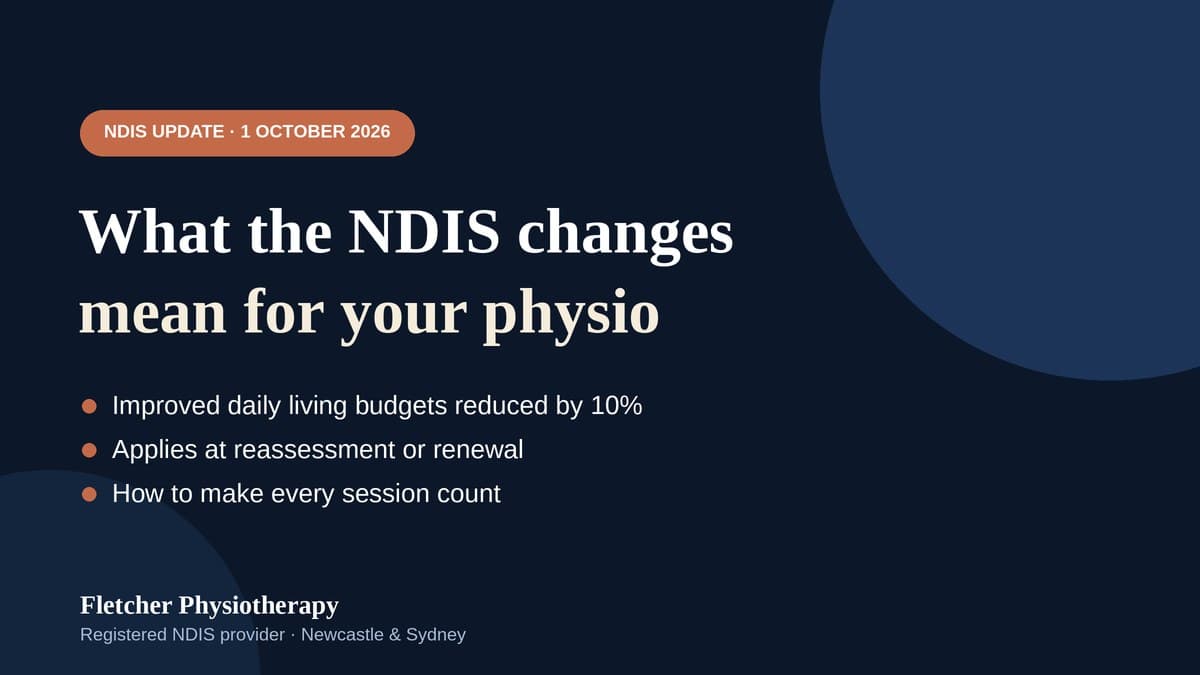
Quick answer: what's changing?
From 1 October 2026, the NDIS is resetting funding for some supports in participants' plans:
- Improved daily living budgets (where most physio comes from) are reduced by 10%
- Social, economic and community participation budgets are reduced by 50%
- The change applies when a plan is reassessed or a new plan is approved from 1 October 2026
- Plans being renewed are affected from 1 February 2027
- Some supports are protected, including disability-related health supports and personal mobility equipment
- The reduction applies to your budget, not necessarily to what you actually spend
What this means for physiotherapy
Physiotherapy is usually funded from the improved daily living budget, alongside other therapies such as occupational therapy and speech pathology. A smaller budget may mean fewer funded therapy hours across the year, so planning how you use them matters more than ever.
If you don't currently use all of your improved daily living budget, the change may make little practical difference. If you do, it's worth talking with your therapists and support coordinator now, before your next reassessment.
How to make every physio session count
A few practical steps help your physio budget go further:
- Set clear, functional goals — like walking to the shops or getting in and out of bed safely
- Agree session frequency and costs up front in a written service agreement
- Ask for a home exercise program you, your family or support workers can practise between visits
- Combine assessment, equipment advice and training into fewer, well-planned visits
- Keep an eye on spending in the my NDIS app or participant portal
- Ask for a progress report before your plan reassessment, so planners can see what therapy is achieving
Why reports matter more now
When budgets are tighter, clear evidence helps. A good physiotherapy report explains what you can and can't do, why, what therapy is aiming for, and what support is recommended. That gives planners what they need to decide what's reasonable and necessary for you.
If your functional capacity or circumstances change significantly, you can still ask the NDIA for a change to your plan, and a recent report can support that request.
How Fletcher Physiotherapy can help
We're a registered NDIS provider (NDIS0023718), so we can work with agency-managed, plan-managed and self-managed participants. We provide physiotherapy at home across Newcastle, Lake Macquarie and the Central Coast, and around Sydney Olympic Park and the Inner West from 9 November 2026.
We'll help you plan sessions around your goals and budget, set out costs clearly before we start, and provide reports for your reassessment. Our founder Daniel Lee is an APA Titled Pain Physiotherapist and speaks English and Korean. To talk it through, call 0404 791 756 or visit our NDIS physiotherapy pages for Newcastle and Sydney.